

transformation through twining
on the cordage practice of Saoirse Byrne

This May, I had the pleasure of participating in this year’s edition of XTANT, where I met many talented and fascinating individuals. As I’ve been sitting with these exchanges, there were two women in particular whose stories I want to share ~
I’ll begin with Saoirse.
Saoirse Byrne
I met Saoirse during set-up, where she was laying out her corded necklaces and armbands on a large wooden table. Each piece is handtwined from textile scraps, many of which she naturally dyes, while others are from end-of-life clothing.
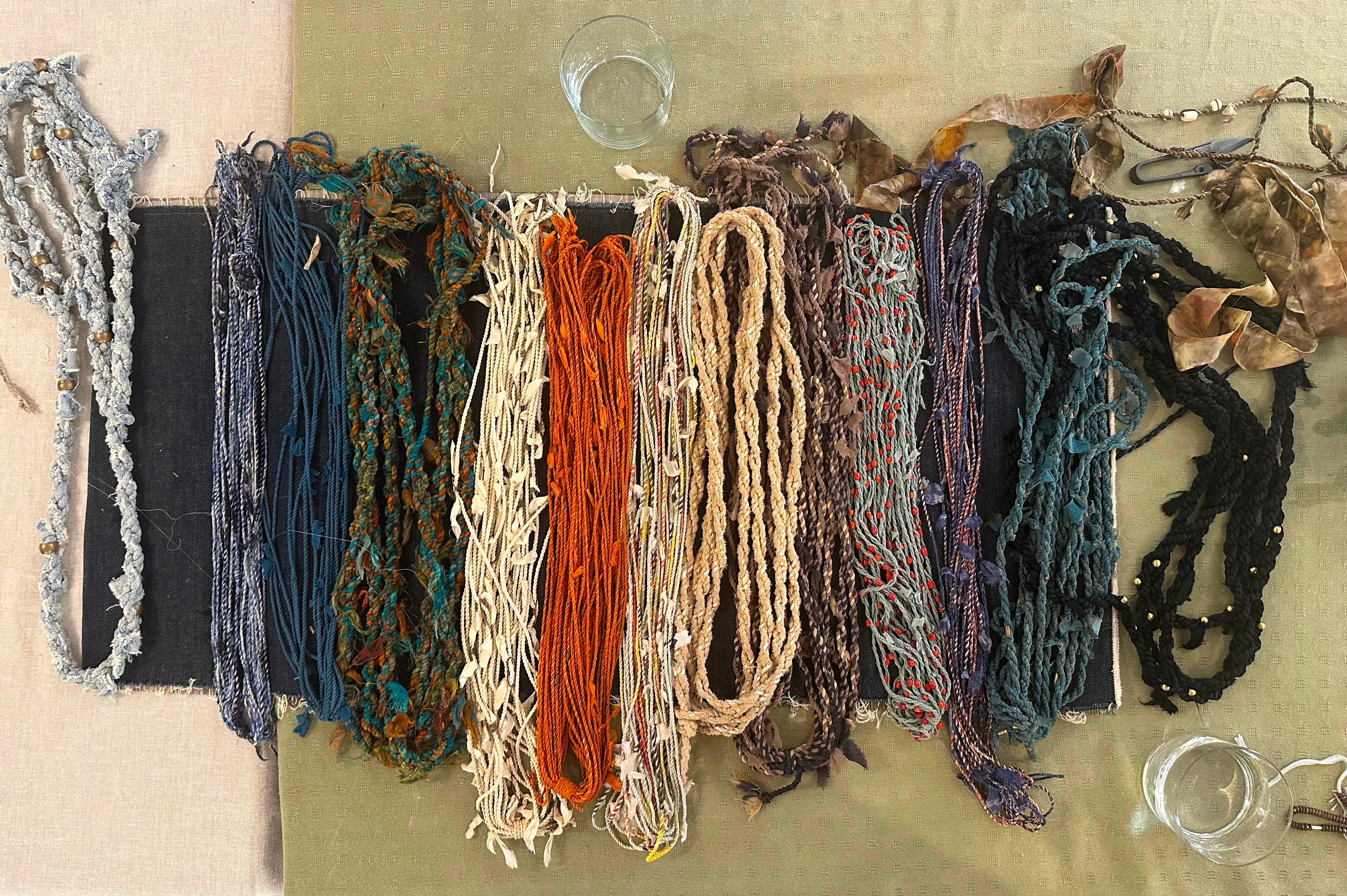
Her cords were in all degrees of thickness, from elegantly fine and dotted delicately with beads to more wild and sturdy, such as blue jeans corded into thick strands. Saoirse shared that they were made from the ripped jeans of her daughter, who is an avid horseback rider and trainer.
Besides both being from the US, we discovered that we shared connections to a women’s gathering in the Pacific Northwest — of which I wrote in a previous letter. What we didn’t discover then, yet I am learning in writing this, is that the woman who taught Saoirse to twine — Tamara Wilder — is the same woman I did an empowering workshop about women’s health with in 2024.


Back at XTANT Saoirse was passing along the torch, sharing her skills and knowledge through the workshop, The Art of Handtwined Cords, that I was lucky enough to attend. She always had a sensibility for materials, she told us, having studied fashion design (BFA) and Sustainability (MBA) before going on to discover cording. When she did, it completely transformed her way of working with material. Piles of previously unusable scraps were reborn into satisfyingly beautiful lines of cordage. Old clothing, a worn-out t-shirt, could become nearly unrecognizable as a gracefully layered necklace.
“In its simplest form, cordage is a line – a boundary or a life line – connecting us to where we have come from and drawing us forward.”
With patience and deep reverence, Saoirse responds through her practice to those around her. After her mother was brought to the ER for brain surgery and her favorite shirt was cut off of her, Saoirse transformed the shirt into a delicate necklace, using bits of oxygen tube as beads.
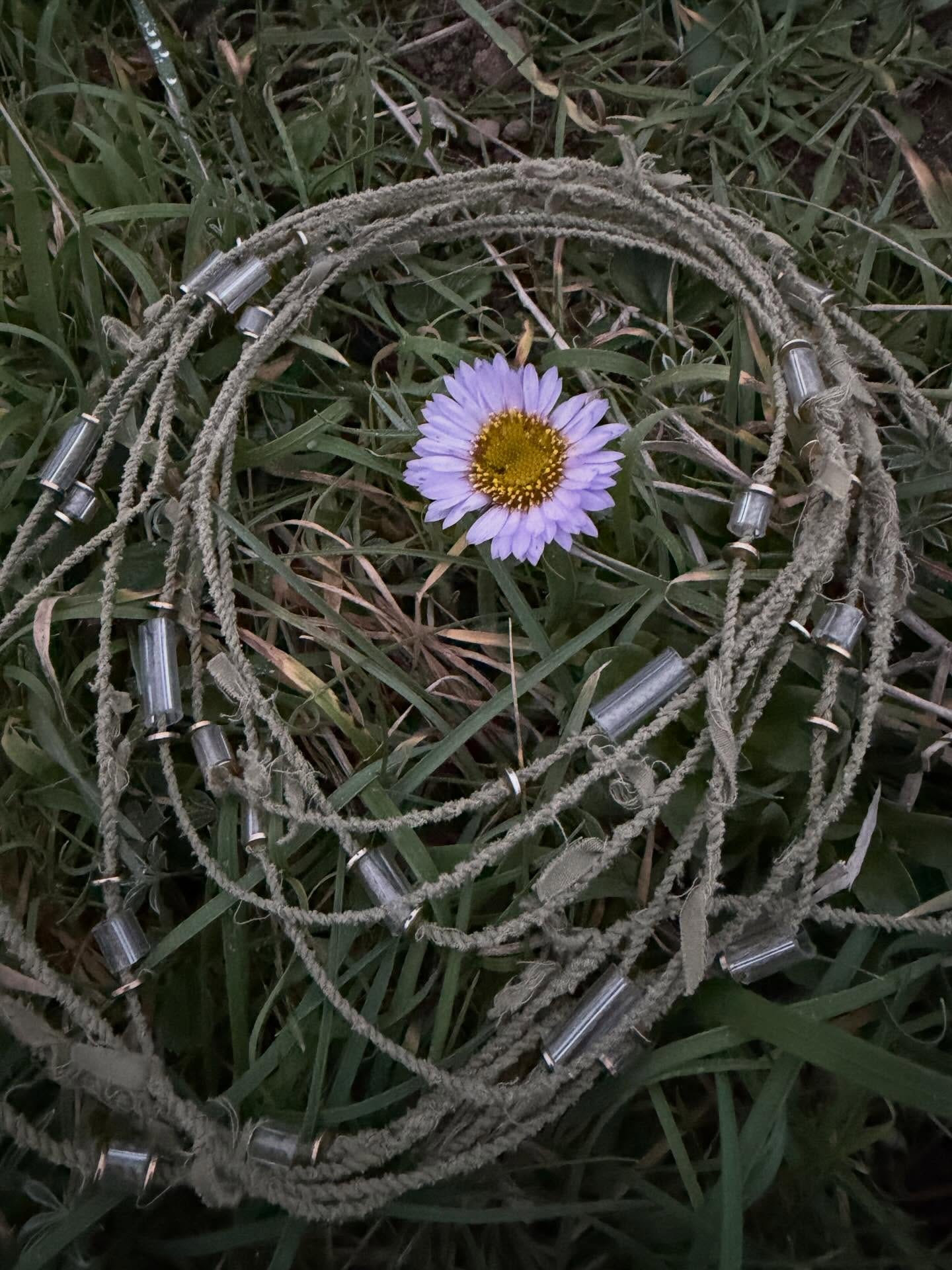
Through her own experience, and by sharing this with others, Saoirse shows how creating cordage can support the processing of grief, the letting go, and the honoring of a life well lived.
“By taking fabrics that hold memory and transforming them into meaningful lengths of twine that can be worn or used, we can bring a new joy and explore the beauty, the heartache, the grief, the acceptance of what it is to be human — we transform the object and invite ourselves to do the same.”
~
Thank you Saoirse, for sharing your story and your wisdom. It is a privilege to meet makers like you, whose dedication and presence invite a grounded awareness from which to gaze with more wonder at the world around us.
~
more soon.
with love,
Fiona